Plant care
Fertilizer Numbers Explained: NPK & Brand Comparison
Fertilizer numbers tell you the product’s nutrient analysis, not how much your plant needs. Start with the plant, its growing conditions and the product’s directions before choosing a bottle with a bigger number.
What do the three numbers mean?
On US fertilizer labels, the three numbers describe percentages by weight: nitrogen (N), phosphate expressed as P₂O₅, and potash expressed as K₂O. They are commonly called NPK, although the second and third numbers are not percentages of elemental phosphorus and potassium. University of Maryland Extension explains fertilizer analysis.
For a simple arithmetic example, 100 grams of a 10-5-5 product represents 10 grams nitrogen, 5 grams phosphate and 5 grams potash on that label basis. This is an explanation of percentages, not an application recommendation.
A 10-5-5 and a 20-10-10 have the same 2:1:1 ratio, but different concentrations. That does not make their scoop sizes, dilution instructions or application schedules interchangeable.
What do N, P and K help a plant do?
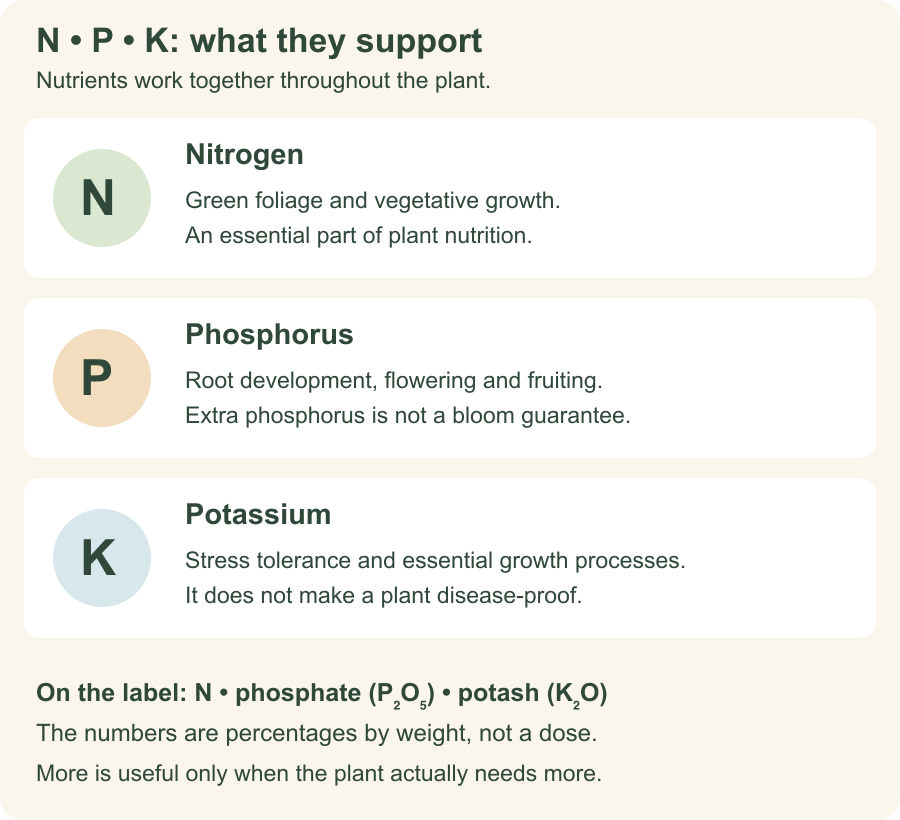
Nitrogen supports green foliage and vegetative growth. Phosphorus contributes to root development, flowering and fruiting. Potassium supports stress tolerance and other essential growth processes. These roles overlap across the plant; they are not three separate “growth switches.” Adding extra phosphorus does not guarantee more flowers, and extra potassium is not a disease treatment. University of Wisconsin Extension explains the roles and why soil testing matters.
Separate four questions when comparing products
| Question | Where to look | Why it matters |
|---|---|---|
| What nutrients are supplied? | Guaranteed analysis | NPK alone does not describe every included nutrient. |
| What are they derived from? | Ingredient or derived-from statement | Source and concentration are different questions. |
| How is the product delivered? | Liquid, soluble powder, granule or other formulation; release instructions | Product form does not replace the application directions. |
| Is it appropriate here? | Listed plants, growing situation, rate and frequency | A garden-bed instruction is not automatically a houseplant instruction. |
This comparison framework is an original worksheet, not a ranking of brands or a catalog of every US fertilizer.
Fertilizer brands at a glance
Explore 31 product formulations from 15 US-market brand groups, organized by product purpose, organic status and verified indoor/outdoor uses. Expand a brand to see product names, NPK numbers and manufacturer sources. This is a research sample checked October 26, 2026, not a complete US product inventory or a brand ranking.
① Product purpose ② Organic status ③ Indoor / outdoor
Organic
All-purpose & houseplant
Burpee · Outdoor
Dr. Earth · Outdoor
E.B. Stone · Outdoor
Espoma · Outdoor / Indoor
Jobe’s · Outdoor
Neptune’s Harvest · ?
True Organic · Indoor + outdoor
Fruit, flower & vegetable
E.B. Stone · Outdoor
Espoma · Outdoor / Indoor + outdoor
FoxFarm · ?
Jobe’s · Outdoor
Kellogg Garden Organics · Outdoor
Non-organic
All-purpose & houseplant
ferti-lome · Indoor + outdoor
Fruit, flower & vegetable
ferti-lome · Outdoor
FoxFarm · ?
Organic status unverified
All-purpose & houseplant
Jack’s Classic · Indoor + outdoor
Miracle-Gro · Indoor + outdoor
Southern Ag · Indoor + outdoor
Fruit, flower & vegetable
Alaska / Pennington · Indoor + outdoor
Jack’s Classic · Indoor + outdoor / ?
Jobe’s · Outdoor
Neptune’s Harvest · ?
Settings shown are verified uses, not exclusions. “?” = not verified. Organic = manufacturer claim. Classification applies to the listed products, not the whole brand.
Organic versus synthetic is not a dosing rule
Organic-source products and manufactured fertilizers can both supply nutrients. Read the actual analysis and directions rather than treating “organic” as permission to add more. Also distinguish a general organic-source description from suitability for certified organic production. Colorado State University explains these distinctions.
A shopper comparing two bottles should record their nutrient analysis, intended use and instructions side by side. The useful question is “Which fits this plant and situation?” rather than “Which category always wins?”
Does an acid-loving plant need a different fertilizer?
Soil pH affects nutrient availability. Fertilizer strength and pH are different properties; the NPK numbers do not report the pH of your soil. For outdoor beds, use a soil test and recommendations appropriate to the plant and location before adjusting pH. Maryland Extension explains the relationship between pH and nutrients.
Do not interpret a yellow leaf as proof that a plant needs an acidifying product. First establish what is wrong and what conditions the species needs.
For houseplants, check growth and the label
Products labeled for houseplants can have different dilution rates for different application frequencies. Copy both the amount and the timing; do not take the concentration from one instruction and the frequency from another. Excess fertilizer can cause salt buildup. Reduced winter light and growth can also reduce the need for feeding. Maryland’s indoor-plant fertilizer guidance explains these cautions.
Before treating a declining plant, investigate moisture, drainage, light and pests. Fertilizer does not fix those problems simply because the leaves look unhealthy. Maryland’s fertilizer basics explicitly distinguishes nutrient needs from other causes of injury.
Two real-life label-reading examples
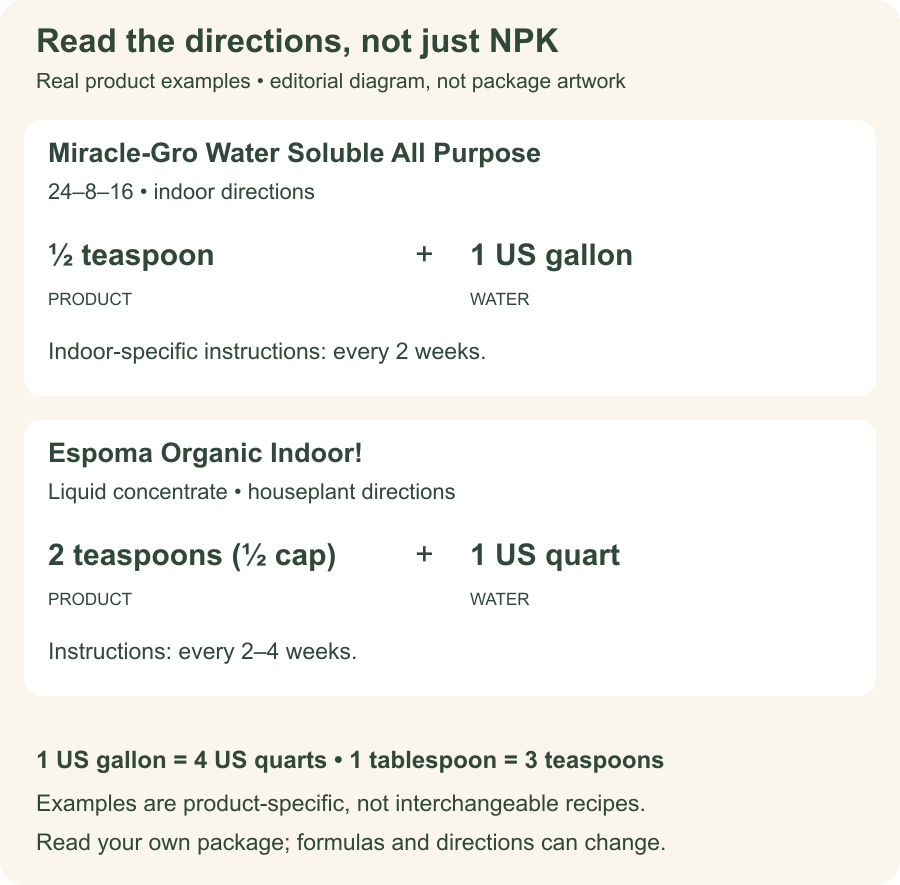
Original diagram summarizing manufacturer directions checked October 26, 2026; not a photograph or reproduction of packaging. These are reading examples, not endorsements or instructions for a different product.
Example 1: Miracle-Gro Water Soluble All Purpose Plant Food (24-8-16). Its US manufacturer page separates indoor and outdoor directions. The indoor-specific instructions specify ½ teaspoon per gallon of water and application every two weeks; the broader page also lists a 7–14-day interval. Read the indoor instructions on your own package rather than combining sections. See the manufacturer’s instructions and view the actual manufacturer-linked label.
Example 2: Espoma Organic Indoor! The manufacturer specifies two teaspoons (half its cap) per quart, with feeding every two to four weeks. It also instructs users to shake before mixing and remove collected runoff from the saucer. See Espoma’s product and directions.
A US gallon contains four US quarts; a tablespoon contains three teaspoons. Those differences matter. The mixture is watering solution, not a requirement to pour a whole gallon or quart into one pot. Follow the exact product’s directions and your plant’s needs. Do not copy the cap, scoop or interval from another bottle. If your package differs from a web example, resolve that difference with the manufacturer before using it.
Copy this label worksheet before buying or applying
Download the printable fertilizer label worksheet (PDF, 1 page)
Print on US Letter at actual size, or choose “Fit to page” for A4.
- Plant and growing situation: indoor pot/outdoor container/bed:
- Reason for considering fertilizer:
- Evidence of need or relevant plant-care guidance:
- Product name and photo of the full directions:
- NPK and other listed nutrients:
- Intended plants and use:
- Form and release instructions:
- Exact labeled amount and unit:
- Exact dilution or treated area/container size:
- Exact frequency:
- Other fertilizer already used, including any listed in the potting mix:
- Missing information to resolve before application:
Leave uncertain fields blank rather than guessing. Keep products in their original labeled packaging and follow the label’s handling and storage instructions.
How LetMeGrow helps with fertilizer decisions
LetMeGrow connects your real plants with a cozy pixel garden. For a Garden plant, open Care → Fertilizer review to check active new growth, whether the plant is stressed, dormant or recently repotted, whether the product label suits it, and whether the label’s interval has passed since the last feeding.
The review date prompts you to check; it does not prescribe a dose or tell you to fertilize automatically. You can record a decision to wait, and a completed check can still contribute to Garden progress. That makes observing your real plant part of the game without encouraging unnecessary fertilizer.
If the plant is declining, Diagnose can offer possible causes from a photo and the context you provide. It does not test soil nutrients or replace the product label. Saved care features require a connected account; AI features are subject to usage limits and availability.
Download LetMeGrow on the App Store to connect careful real-world plant care with your pixel garden.